Cleaning services in Leeds - West Yorkshire. Methods, access and the proposed scope assessed for your property.
Roof cleaning and assessed moss removal for properties in Leeds
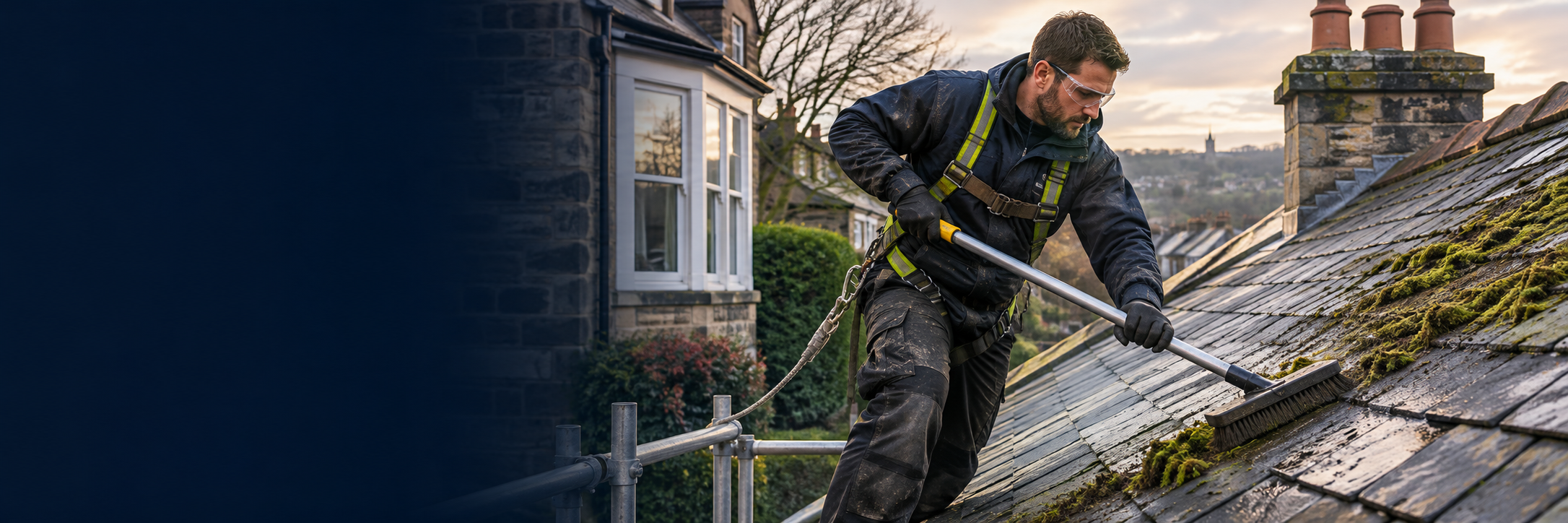
Roof cleaning in Leeds should begin with the roof covering and its condition, rather than a decision to use a particular machine. Moss, algae, lichen, loose debris and weathered surface deposits can occur in different combinations, and they do not all call for the same response. Nova Clean Leeds discusses roof cleaning and moss removal for suitable residential and commercial coverings, with the method, access and working boundaries assessed for each property. Cleaning is considered alongside the condition of tiles, slates, flashings, gutters and surrounding features, while repairs and technical roofing work remain clearly identified as separate tasks.
A quotation enquiry is more useful when it includes the postcode, photographs from a safe ground-level position and any available information about the roof material. Explain the approximate size, height, roof shape and access around the building. Mention conservatories, extensions, solar panels, roof windows and neighbouring structures. These features can affect the cleaning arrangement as much as the amount of moss visible. Availability and suitability are confirmed for the actual property, without assuming that every covering can be treated in the same way.
Establish the roof material before discussing a cleaning method
Concrete tiles, clay tiles, natural slate and metal coverings have different characteristics. Age, previous coatings, installation details and existing deterioration can further change what is appropriate. A surface that appears strong from the ground may have weak edges, a fragile coating or movement that becomes apparent only during a competent inspection. Where the material is uncertain, that uncertainty should be resolved before work is specified. The purpose of the assessment is to identify a suitable approach, including the possibility that cleaning should be limited or postponed.
Manufacturer guidance and any relevant warranty conditions should be considered where available. Some methods or products can be unsuitable for particular roof coverings or treatments. A generic claim that one pressure setting is safe for every roof does not account for those differences. Please share documentation from a roof installation, repair or coating if you have it. If a material needs specialist advice, that advice should inform the cleaning scope rather than being replaced by a promise of a uniform visual result.
Distinguish moss growth from damage to the covering
Visible growth can make a roof look heavily affected, but appearance alone does not reveal whether a tile is sound, whether a joint has failed or whether water enters elsewhere. Cleaning can remove recoverable deposits from suitable surfaces; it does not repair broken tiles, defective flashings or a leak. Explain any known problems at the first enquiry. Where the roof already needs repair, the appropriate sequence should be agreed so a cleaning intervention does not take place on a covering that is unsuitable for disturbance.
Likewise, a darker or patchier area is not automatically contamination that will disappear with more aggressive treatment. Weathering, variations between replacement tiles and earlier coatings may remain visible after cleaning. The expected outcome should reflect those conditions. A sensible assessment distinguishes removable growth, permanent colour differences and defects requiring another trade. This helps avoid unnecessary repeat treatment of a surface simply because it does not match a photograph of a newly installed roof.
Plan safe access without treating the roof as a walking surface
Working at height requires appropriate access and protection for the building, the workers and people nearby. Roof edges, openings, fragile sheets and rooflights create risks that are not resolved by the short duration of a job. An apparently convenient ladder position is not evidence that the whole intervention can be carried out safely from it. The proposed access method needs to follow an assessment of the property and the task, with the necessary arrangements agreed before work begins.
A terrace in Burley, a detached house in Roundhay and an industrial unit in Hunslet present different access questions. Side passages, shared drives, overhead services, gardens and neighbouring buildings can limit equipment placement. Conservatory roofs and lightweight extensions may be fragile and should not be used as access routes. Tell us about these features early. Where scaffolding, a platform or another arrangement is required, its inclusion and responsibility should be explicit in the quotation rather than assumed to form part of a basic cleaning price.
Choose a controlled approach to moss and surface deposits
Depending on the assessed covering, removal may involve carefully controlled manual work or another compatible process. The aim is to address the deposits without unnecessarily disturbing the roof material or allowing loose material to spread uncontrolled. The tools, access position and direction of working all matter. The most suitable process may involve several stages rather than one quick pass. An initial inspection can also identify areas where treatment needs to stop because a defect or uncertain material requires further attention.
High pressure is not a default solution. Water can affect weak coverings, joints, coatings and adjacent features, and the consequences depend on more than the machine setting. A proposed wet method should account for the covering, its installation, the condition of the roof and the collection of residues. Equally, describing a process as soft washing does not by itself prove that its product or application is suitable. Ask what will actually be done and why it is appropriate to the material concerned.
Assess any treatment product and its application conditions
If a treatment product is proposed, it should be suitable for the intended use and applied under its instructions and the assessed working conditions. More product does not automatically mean a better outcome. The specification should account for surrounding plants, neighbouring materials, surface water routes and any restrictions affecting the property. Relevant preparation and protection need to be arranged before application, particularly where a roof drains towards a garden feature, shared yard or other sensitive area.
The appearance of treated growth can change over time, depending on the process and conditions. That should be explained before work is booked. A treatment should not be sold with an unsupported promise that a roof will remain clear for a fixed number of years regardless of its setting. Shade, nearby trees, moisture and other factors can influence future growth. Any follow-up recommendation should relate to the actual roof and the proposed maintenance approach rather than an automatic repeat treatment schedule.
Protect gutters, drainage and the areas beneath the roof
Moss removal can release material that would otherwise enter gutters, outlets and downpipes. The working plan should consider how it will be collected and what protection or subsequent clearing is included. A roof cleaning price should not leave the owner uncertain about deposits gathered at the eaves or material discharged into an inaccessible outlet. Ask which gutters and drainage components form part of the agreed work and whether any checks or additional clearing are proposed.
Protection may also be needed for windows, garden furniture, vehicles, neighbouring access routes and surfaces below the work. The appropriate arrangement depends on the method and the building. An open driveway differs from a roof edge above a busy pavement or a courtyard shared by several occupiers. Explain who controls those spaces and whether access can be restricted. Cleaning should not simply transfer the roof deposits onto areas that someone else must then manage without an agreed scope.
Take particular care around solar panels and roof-mounted features
A roof may carry photovoltaic panels, aerials, roof windows, vents or other installations that impose additional limitations. Roof cleaning does not automatically include cleaning or servicing those systems. Their position can affect access to the covering and the way residues are controlled. Tell us whether an installer or maintenance provider has given instructions or imposed conditions. A panel should not be treated as a platform, and equipment should not be rested against installations merely because they appear convenient to reach.
If solar panel cleaning is also required, it should be assessed as a distinct material and electrical installation. Similarly, work around a roof window needs to protect its seals, finish and surrounding details. Where a component appears damaged or its condition is uncertain, another competent specialist may need to assess it before cleaning proceeds. A combined enquiry can discuss these tasks together while retaining clear boundaries between cleaning, roofing maintenance and the technical responsibilities of other contractors.
Identify coverings that need specialist investigation before disturbance
Older buildings may contain fragile materials or substances that require specialist assessment. Suspected asbestos-containing roofing should not be brushed, scraped or washed as an ordinary moss removal job. Unknown material is a reason to pause and establish the appropriate next step. Tell us about surveys, previous advice and any known restrictions when enquiring. A photograph may help describe the roof but cannot establish all of its material properties or replace an assessment required by a competent professional.
Damaged roof sheets, unstable fixings, poor access and evidence of significant deterioration can also change the proposed work. The appropriate outcome may be referral for repair or a limited cleaning scope rather than a full intervention. We do not treat the removal of deposits as more important than the condition of the building beneath them. Establishing those limits at quotation helps prevent work from being arranged on assumptions that cannot be supported when equipment arrives.
Organise roof cleaning for managed and commercial premises
In a managed building, permission may need to come from a freeholder or agent rather than an individual occupier. Commercial premises may require risk information, method statements, contractor induction and agreed controls for staff or deliveries. Explain the approval process and who can authorise the work. A short description of the roof area does not reveal these requirements, and a booking should not assume that all necessary access and permissions are already in place.
For units in Holbeck, Hunslet or other business districts, equipment placement and exclusion areas may affect vehicle movements. A retail premises can have a roof edge above customer access, while a school or community building may need work planned around occupancy. The programme should reflect those conditions and any weather restrictions. Where several trades are involved, nominate a contact who can coordinate instructions, identify changes and confirm that the premises are ready for the agreed intervention.
Understand the factors affecting a roof cleaning quotation in Leeds
Cost depends on the roof shape, covering, condition, deposit level and practical access, together with the proposed method and protection. Valleys, dormers, extensions and difficult edges can affect working time. The means of collecting residues and any included gutter work also matter. A simple price per square metre cannot describe every roof adequately. A useful quotation explains the surfaces included, the method proposed, the access assumptions and any separate work needed before or after cleaning.
Ask whether the price includes equipment access, protection of surrounding areas, collection of loose deposits, the specified treatment and the clearing of agreed gutters. Clarify any exclusions involving repairs, inaccessible sections, solar panels or specialist materials. Weather may require a change to the programme, so arrangements for rescheduling should be clear. Do not assume that the same quotation covers a change in method or the discovery of a defect; any variation should be discussed before additional work proceeds.
Arrange the work without unsafe preliminary inspection
Use photographs taken from a safe ground position and describe any areas you cannot see. Do not climb onto the roof or an extension to obtain measurements or close views. Tell us about the building height, utilities, access routes, parking and the ownership of neighbouring spaces. Where possible, include the approximate age of the roof and information about previous work. This gives the assessment a useful starting point without expecting you to carry out the contractor’s inspection.
Nova Clean Leeds considers roof cleaning enquiries across the city and surrounding district, including Roundhay, Alwoodley, Horsforth, Pudsey, Morley, Garforth, Otley and Wetherby. Coverage and working arrangements are confirmed individually. At completion, review the agreed areas and note any permanent weathering, excluded sections or recommendations concerning repairs and maintenance. Keep the specification with the roof’s existing records. It provides a clearer account of the intervention than a broad claim that cleaning has restored every component of the roof.
Discuss your Leeds cleaning requirement
Send the postcode, photographs taken safely and a description of the affected surfaces. We will discuss access, the work required and availability before confirming the next step. A quotation should identify what is included, any separate specialist work and the assumptions on which the price is based.
Request a cleaning quote0845 52 805 20